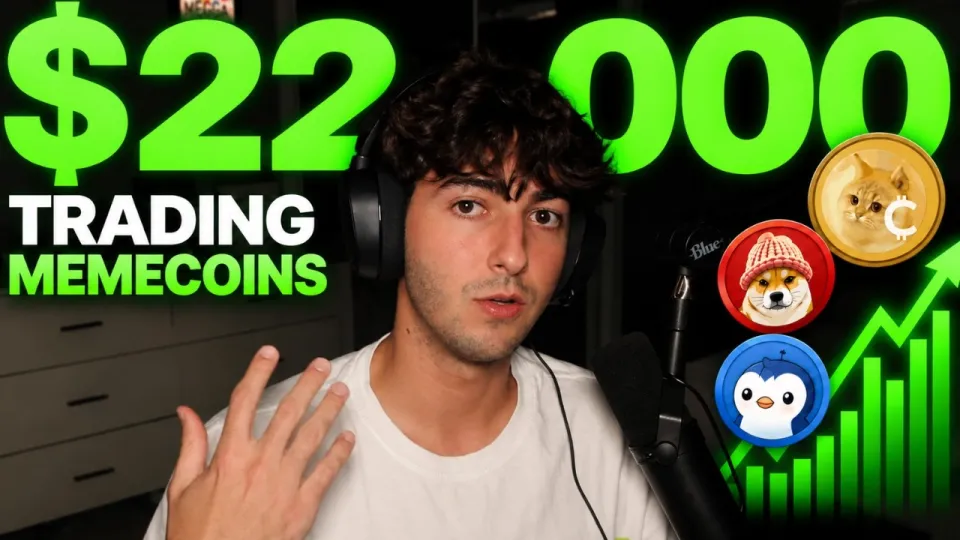
Meme coin: How a Single Trade Turned Into $22,000 — A Full Breakdown
You can order the same kind of articles for your own video to boost it on YouTube and Google. Just message the Telegram bot @sat_sit_bot. The bot writes and publishes the articles itself (with your YouTube video embedded) on popular topical websites (no ads). Your first 50 articles are free.
Key takeaways
- The trade described by Megga produced a reported $22,000 profit from one meme coin position.
- Meme coin P&L is driven by entry timing, position size and exit discipline, not by holding long term.
- Liquidity and holder concentration are the two fastest ways to check rug risk before buying.
- Megga points viewers to a free beginners guide at whop.com/wiredd and trades via the Padre terminal.
- A $22,000 result on a small account implies a large multiple, which also means a large drawdown risk.
A meme coin trade can turn a few hundred dollars into five figures when entry timing, position size and exit discipline line up — that is exactly the outcome Megga describes in a single trade worth $22,000. The mechanics are not magic: buy early on a token with real liquidity, size the position so a total loss is survivable, and sell into strength before the crowd does. Megga walks through that process in a full guide and points beginners to a free beginners guide on Whop as the starting point.
What a $22,000 meme coin trade actually requires
The headline number is the result, not the strategy. A $22,000 profit on a single meme coin position means the trader captured a large multiple on the capital deployed, and multiples of that size only exist in tokens with thin early liquidity and fast-moving narratives. Three variables do the work:
- Entry price. Getting in before the first wave of buyers is the difference between a 3x and a 30x. That usually means monitoring new pairs and social signals rather than waiting for a chart to form.
- Position size. The dollar amount risked must be small enough that a rug or a 90% drawdown does not end the account. A trader risking $500 to make $22,000 is taking a very different bet from one risking $10,000.
- Exit plan. Meme coin gains are unrealized until sold. Selling in tranches — part on the first leg up, part on a target, a remainder on a trailing stop — converts paper profit into a realized number.
Anyone quoting a five-figure meme coin win is quoting the best case. The same setup, with the entry ten minutes later, is a loss.
Reading a token before you buy
Before any capital goes in, a meme coin needs a basic safety check, because most new launches fail or are designed to extract money from buyers. The checks that matter most:
- Liquidity depth. A pool with a few thousand dollars cannot absorb a large sell without collapsing the price. Check how much liquidity sits in the pair and whether it is locked.
- Holder concentration. If one wallet holds 20% or more of supply, that wallet can dump on you. Distribution scanners show the top holders in seconds.
- Contract permissions. Mint authority and freeze authority still active means the developer can change supply or lock wallets. Renounced contracts remove that lever.
- Volume versus market cap. Healthy turnover suggests organic interest; a market cap that jumped 10x on almost no volume usually means a handful of wallets trading with themselves.
- Social footprint. An account created the same day as the token, with bought followers, is a warning, not a signal.
None of these checks guarantees a winner. They filter out the obvious traps so the remaining risk is price risk rather than counterparty risk.
How the trade is executed: tools and workflow
Execution speed and order routing decide whether a fast meme coin trade fills at the price you saw or 30% higher. Megga trades through the Padre terminal, linked as trade.padre.gg/rk/megga, which is built for Solana-style meme coin sniping with custom priority fees and quick buy/sell buttons.
A workable workflow looks like this:
- Watch new pair feeds and social channels for early candidates.
- Run the safety checks above and discard anything with unlocked liquidity or a dominant holder.
- Set a fixed budget per trade — an amount you can lose entirely without changing your life.
- Enter with a market or aggressive limit order, then immediately place a stop and a first take-profit level.
- Sell 30–50% on the first strong move, move the stop to breakeven, and let the rest run with a trailing exit.
The discipline point is that the exit is decided before the entry. Traders who improvise on the way up usually give the gains back on the way down.
Typical doubts about big meme coin wins
The most common objection to any five-figure meme coin story is that it cannot be reproduced by an ordinary trader, and that objection deserves a straight answer. Three things genuinely skew results in these videos:
- Audience effects. A creator with a large following can post a token and watch buyers arrive. A trader without that audience is always later to the move.
- Group trading. Coordinated groups enter and exit together, which smooths their fills and worsens everyone else's.
- Survivorship. Losing trades rarely become videos. A $22,000 win may sit alongside several positions that went to zero.
The honest takeaway is not that the result is fake, but that the edge is partly social and partly timing — and that a solo trader should size positions as if the next ten trades could all fail. Smaller challenge formats, starting from $25–$100 and building toward $1,000, are a more realistic way to test whether a strategy holds up.
Risk management rules that keep accounts alive
Risk control is the only part of meme coin trading fully under the trader's control, so it deserves hard rules rather than good intentions. Practical limits:
- Cap any single position at 2–5% of the trading stack.
- Never add to a losing meme coin position; averaging down on illiquid tokens is how accounts die.
- Take the initial capital off the table after the first 2x so the rest of the trade is house money.
- Track slippage and priority fees — on small caps they can eat a meaningful share of a thin profit.
- Keep a written log of entry thesis, exit and result; patterns only become visible across dozens of trades.
A trader who risks 3% per position can be wrong twenty times in a row and still be trading. A trader who risks 50% is out after two mistakes.
All links from the video
- Free beginners guide: whop.com/wiredd
- Trading terminal: trade.padre.gg/rk/megga
- Twitch: twitch.tv/megga
- TikTok: tiktok.com/@meggafaze
- Twitter/X: twitter.com/megga
Conclusion
A $22,000 result from one meme coin trade is a real outcome of a repeatable process: early entry, small position size relative to the stack, and a pre-planned exit. The number is exceptional, but the method — safety checks, fixed risk per trade, staged selling — is ordinary and can be practiced on much smaller amounts. Megga's breakdown is worth watching for the workflow around the trade rather than the profit figure alone, and the free beginners guide on Whop is the logical next step for anyone who wants to test the approach with money they can afford to lose.
Source: How I Made $22,000 in a SINGLE Memecoin Trade (FULL GUIDE) · Markdown version
Questions & answers
How realistic is a $22,000 profit from one meme coin trade?
It is possible but rare, and it depends on a large multiple on a small position. Most meme coin launches fail, so the same approach produces many small losses around any big win. Treat the figure as a best case, not an expectation.
Do I need a special trading terminal for meme coins?
A dedicated terminal helps because it offers faster order routing, custom priority fees and quick exits on new pairs. Megga uses the Padre terminal, but any tool that shows liquidity, holders and slippage clearly can work for a disciplined trader.
What is the biggest risk when buying a new meme coin?
Liquidity and holder concentration. If the pool is thin or one wallet controls a large share of supply, the price can collapse the moment that liquidity or those tokens are sold. Check both before entering.
Can a trader without a large following copy this strategy?
Yes, but with adjusted expectations. Creators with big audiences get faster fills and more exit liquidity, so a solo trader should use smaller positions, tighter risk limits and smaller challenge-style targets to test the process.